Saturday, November 10, 2012

Zombie is on Pinterest!

Months of avoidance. Prodding from friends. "I don't need another online addiction," I told them. Pins and re-pins from several of my blog posts later... I finally bit the bullet and signed up for Pinterest. Within two hours, I was hooked. For those of us visual processors and OCD organizers, this is your dream site. You can categorize and store ideas/pictures/links/recipes with the click of a button.

What I found, surprisingly, was that it's the same thing I've been doing on my Facebook page. The "Timeline" interface works virtually the same way. All your links and pictures and "shares" are stored for your friends and yourself. But Pinterest is much more user-friendly. And Pinterest is just for me, and for whoever else chooses to follow me. And whoever I choose to follow.

So come join me! http://pinterest.com/mathbymandy/  or click the "Follow me" Pinterest link at the top of the page. We can share math ideas, decorating tips, recipes, and pretty much everything I blog about anyway. Just no time wasted with words. 

Here's a sample of the "math board" I've started pinning:


I'm going to start back-tracking through my blog posts and create a pin-board of old topics, for easier access to fellow Pinterest math buddies. So stay tuned for that.

Happy pinning!

P.S."Bungie Barbie" Year 2 starts on Monday! I'll have new teaching ideas and pictures to post soon to both my blog and Pinterest :o)


Tuesday, October 23, 2012

When politics and religion spill over into the classroom


It's conference week in my district and just a few short weeks away from voting day. I have been hemming and hawing whether to post my personal views on politics on Facebook, on my blog, in my yard, on my car, in the classroom, or wherever... because honestly, how often do you really change someone's mind? I would think by now that you know who you're voting for. I am hoping not to have any political conversations with parents at conferences either. We are here to talk about your KIDS. Not your own political views on the economy, foreign policy and the unemployment rate. 

I don't go stomping down into parents' offices or homes, and tell them how to be better parents (although I have plenty of suggestions for some, being a parent myself). I don't tromp down to the political headquarters of whatever party is currently in power, and tell them how better to spend my tax dollars... though maybe I should do that too... like LESS CAMPAIGNING! Especially hurtful and misleading campaigns that do nothing but confuse and anger the populace. How about you politicians just take 10 or 20% off the top of your campaigns, across the board, and give THAT to education? Because, let me tell you, us teachers have plenty of ideas of how we'd like to spend YOUR money... 

Like filling our students' accounts with enough money to eat a decent breakfast and lunch. Like adding extracurricular bus routes so the low income students and kids from single-parent families can actually stay after school to get homework help without having to wait around until 6 for a ride home. Like adding more computers and Smart boards to classrooms so students can interact with curriculum and get quicker feedback on their performance. Like funds to hire more educational assistants to help needy students in mainstream classrooms be more successful. But enough of that topic.

There are more important issues that do, truly, spill over into the classroom. That happen to be on the voter's ballot in Minnesota this year. So I'm just going to say it: Homosexuality. I have known several students, parents and close personal friends all through my life who have "come out" at various stages of their lives. They are some of the hardest workers in the classroom, the truest of friends, and the most devout Christians that I have ever met. 

I don't know how anyone who personally knows a gay person, can morally stand by and say "you don't deserve to say 'forever' to someone someday", or "I shouldn't subsidize your health care and benefits with my tax money because you live in sin".  Gay individuals and couples are normal, functional, productive members of society (or at least as normal as us nutty heterosexuals, as we sometimes claim to be). The only difference is in their bedroom habits; which, frankly, are none of your damn business.

The bottom line is, being gay is NOT A CHOICE. I could quote plenty of studies with recent research to support this, but many will never believe it until they have come to know LGBT individuals for themselves. We as teachers are often the first to notice behaviors that might be considered "effeminate" or "sensitive" or whatever word you want to call it when girls are really good at sports. For some reason, it's frowned upon to call someone the N-word, or poor, or a slut, but students think it's still totally okay to call people "gay". When said students eventually "come out" later in life, as they inevitably do, we as their former teachers are rarely surprised.

These students, whether they have declared themselves LGBT or not, (or aren't sure yet, as many teens aren't) are some of the most victimized individuals in the educational system. They are bullied in classrooms; as much as we try to stop it, there are still whispered comments, inappropriate looks and gestures, and notes that pass behind our backs that we don't always catch. There is pushing and shoving and name-calling and touching in the lunch line, in the hallway, at the lockers, in the gym locker room and on buses... and all the bully prevention in the world isn't going to stop a teen from taking advantage of those few precious seconds when an adult isn't watching out for the victim(s). And it is NOT OKAY.

What is even more NOT OKAY, is for conservative individuals and groups to be forcing their religious views about marriage on the CONSTITUTION either of any state or of the country as a whole. The United States of America was founded on the SEPARATION of CHURCH and STATE. I am not telling you what to believe; I am telling you not to tell ME what I should be believe. Because it's not your business. The state of marriage is a CIVIL union that is recognized in LAW that is reinforced by the CONSTITUTION that is NOT a RELIGIOUS document in any way shape or form. 

If individuals want their definition of "marriage" to be between "one man and one woman", then that is THEIR business. But it is NOT their business to decide where their tax dollars are spent; whether they be on heterosexual or homosexual couples' health care benefits, or their death benefits, or any other benefits that should be UNIVERSAL to EVERYONE ANYWAY. If people want to deny benefits to subgroups of "sinners" so badly, then you minus well throw in the 60% or more of Americans who get divorces in their lives. And to those who abuse children and animals. And to anyone who commits a crime or cheats on their spouses. Or steals money on Wall Street. Where do you stop??

It's just another form of discrimination that is being perpetuated in the same way that slavery and women's rights were. Because there are Biblical quotes and verses to back up just about whatever you feel you want to believe anyway.

To those of you who have read this far, you either agree with me, or you're undecided. So let me put it to you this way. If you're going to literally interpret the Bible to say "marriage is between one man and one woman", then here are some other things you must ALSO literally agree to:

(These were originally posted by Cindy Scott, originally on christiangays.com)

Proposed Constitutional Amendment codifying marriage entirely on biblical principles:
  • Marriage in the United States shall consist of a union between one man and one or more women. (Gen 29:17-28; II Sam 3:2-5; Matthew 25:1)
  • Marriage shall not impede a man's right to take concubines in addition to his wife or wives. (II Sam 5:13; I Kings 11:3; II Chron11:21)
  • A marriage shall be considered valid only if the wife is a virgin. If the wife is not a virgin, she shall be executed. (Deut 22:13-21)
  • Marriage of a believer and a non-believer shall be forbidden. (Gen 24:3; Num 25:1-9; Ezra 9:12; Neh 10:30)
  • Since marriage is for life, neither this Constitution nor the constitution of any state, nor any state or federal law, shall be construed to permit divorce. (Deut 22:19; Mark 10:9)
  • If a married man dies without children, his brother shall marry the widow. If he refuses to marry his brother's widow or deliberately does not give her children, he shall pay a fine of one shoe and be otherwise punished in a manner to be determined by law. (Gen. 38:6-10; Deut 25:5-10)
And here are some more Biblical contradictions on Marriage (same source):
  • He who finds a wife finds a good thing. (Proverbs 18:22)
  • It is good for a man not to touch a woman. (1 Corinthians 7:1)
  • A man shall marry his brother’s widow. (Deuteronomy 25:5)
  • A marriage between a man and his brother’s widow is unclean. (Leviticus 20:21)
  • It is better to be unmarried and a virgin, and live in a right way in undivided devotion to the Lord. (Paul -- 1 Corinthians 7:32-35)


So back to the classroom issue. If I could talk to my students (and everyone else) about this, which I dare not, I would say:

Think for yourselves! The Bible is a guide and clearly not meant to be taken literally. We live in modern times and we need to change with the times. Gay people are not a threat to you. They are not trying to push any agenda on you or convert you to their alternative lifestyle. They just want the same rights and responsibilities as any other American citizen to "life, liberty and the pursuit of happiness". And I would add "love" to that list. Because, what is life, if one hath not love? And what is love, if you cannot have your happily ever after, forever?

And if all else fails, go out and meet a gay person! Get to know them. Ask them questions. Get informed. And only THEN you have earned the right to form your own opinion.

Monday, October 15, 2012

Zombie Déjà vu

Happy October!

We here in Minnesota seem to be teetering between late summer and an early winter with scarcely a fall day in sight. Maybe it's still to come. And maybe we'll actually hit 70 degrees tomorrow! (at any rate, I refuse to pull out my closed-toed shoes until there's snow on the ground)

I was looking at my blog stats and marveling at the wonder of Pinterest, in skyrocketing my "Springtime Fun in Zombieland" post to #1 with over 1700 hits. I have not yet signed up for Pinterest, knowing that I will likely become instantly addicted... much as one avoids a fine bar of chocolate or bottle of fancy wine. But I would like to thank Megan Wismer for the original pin that sparked the tide wave of interest in my PEMDAS foldable. 

Several people have asked me what I put inside the flaps; and to them, I say, "to each student, his own". My suggestion is to have them put the basic rule and an example on the outer flap, and to use the work space underneath the flap to write down more examples that they'd likely screw up, that they need to practice. Don't overthink it. But I do find that doing things in a consistent color pattern, like rainbow order, helps with sanity. 

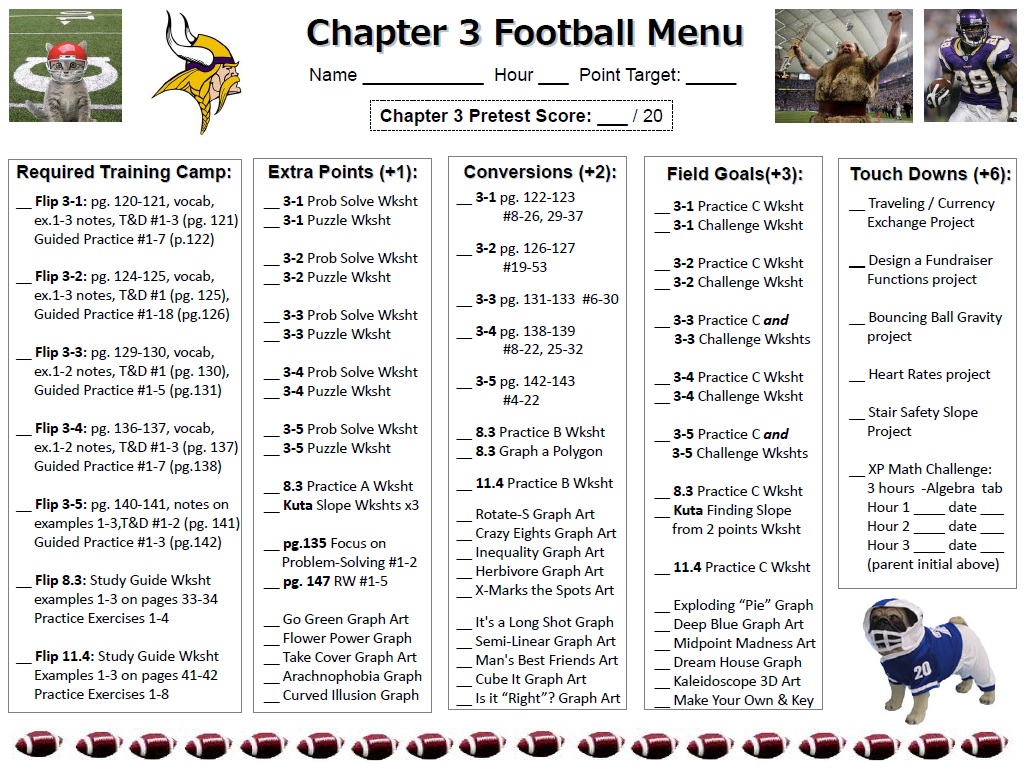
Take this new math menu for example... We are on Chapter 3 and my students are finally getting into the rhythm of what Flip Class is, and are getting sick enough of my "how to take good notes" lectures that most are actually taking good notes...

I am maintaining consistency by color-coding EVERYTHING in the same manner for EVERY chapter, all year long (if I can afford to buy more of my favorite paper colors). That way, when students ask me what they should work on next, I can say, "choose from anything orange". And then they usually take the time to look at all the orange choices before deciding on a puzzle, or a reteaching sheet, or just doing the book problems listed.

Lesson 1 - pink
Lesson 2 - orange
Lesson 3 - yellow
Lesson 4 - green
Lesson 5 - light blue
Lesson 6 - teal
Lesson 7 - purple
Lesson 8 - brown
Lesson 9 - gray 
Lesson 10 - cream
Projects - white


It feels like déjà vu reposting about math menus, but I do feel the need to state how well homework menus work with Flip Class. Students are loving having choices, and many are pushing themselves to try extra assignments, at higher levels of difficulty. They are doing more in their free time as well; simply because they want to, not because they have to. Yes, I give them extra credit for doing so, but honestly, when you have 110% in class already, what is the motivator for doing more work, other than to prove that you can? (the record of 126% still stands from 2 years ago)

Three chapters in, my list of Flip-Class questions from last month has some answers!

Student Questions:
-what do I write in my notebook when I'm reading my flip lesson? 
Summarize and add pictures, copy down important rules & vocab, use highlighter, colors, and write down any answer checks you do. Star it if you solved it correctly on your own!

-how do I take notes on an example without just copying down exactly what I read? 
Cover up the example and try each step on your own, then reveal. Write down your way if you liked it better, or questions that came up, or both ways if you're not sure, or if you don't get it. This works for Video Tutor as well: pause the video at the first step and work out as much as you can on your own; then hit "play" and see how the video did it, compared to your way. Were you right?

-when do I give up on the book, and switch to the video tutor? 
This drives me CRAZY. Kids getting online and saying "I don't get it!"... well, I ask them... did you TRY the example on your own before looking at the book's method? Did you actually read the description? Did you hop online or onto Schoology and ask for help? Because I'd be happy to explain it to you another way, just text me! (yes, they have my cell #) Still no answer? THEN try the video tutor. Or maybe you should just do that first. Kay? You can always fast-forward the video tutor, or skip to the next step. You can't do that to me in class, as much as you'd like to.

-where do I go to get help if I get stuck on a math problem? (at home or in class)
PLEASE try to get help the night before from a study buddy, or from ME, or from the video tutor or your parents. You can at least write down the steps to the problem that you think are right, with question marks of where you got stuck.
 
-when is it OK to ask the teacher for help, vs. when ask my friends or work on my own?
This is another continuing battle. We are still struggling with "reading for meaning"; especially, how to read a lesson and understand the examples provided, and how they relate to the math rule being taught in the lesson. The "I don't get it" comment drives this Zombie absolutely batty. "You don't get it YET"... I throw back at them; wise words from my amazing coworker/mentor/friend.
 
-what is the difference between comparing answers, and copying answers?
Students are not allowed to ask "what did you get?" until all parties have worked out the whole problem and gotten to an answer, or have some work done and are stuck on a particular step. I love this because they often get into arguments about who is right, and then I come by to assist, and reward the winner, and everyone else goes "AAAAAAAAAAAAH! I get it NOW!"
 
-how to ask for easier/harder/independent work and when to ask 
I was hoping to utilize our wonderful textbook as much as possible to save trees. But the reality is, the lowest students need a summary/reteaching worksheet often instead of the book flip lesson. It takes out the wordy description and just gives the rule with a few examples, and then scaffolds them through a few problems. Everyone else does the normal flip (listed on the menu above). THEN the real fun begins. 

Work time rolls around (they usually have 40-50 minutes per day) and students can pick between the book assignment, a standard level worksheet, a harder worksheet, a challenge worksheet, a brain teaser puzzle, a problem-solving worksheet, or a real-world project. These don't have to be finished before they leave; they simply pick them back up the next day and continue where they left off. Pre-test scores are used to determine how many points students must earn to complete the menu (purple/standard might do 20 points, where gold/advanced would do 30 points or higher) and they MUST pick something from each lesson.

My Teacher Questions
-how to pull students into needs-based groups without embarrassing them
Stop worrying about embarrassing them. They know exactly who is low at math and who needs more help. If it's that big of a deal, grab individuals from their desk in groups of 2-3 instead of 5-8 or seat them together on purpose near the front so you can touch base more often.

-how much whole-group instruction and review of "flip" notes is needed each day
Their attention span seems to wane after 10 minutes. We are spoiled rotten with 75-minute math periods, so I do a warm-up or an exploration for 10 minutes while I check in with each student on flip-lesson completion. Once I've circulated to everybody, we go over the intro activity for ~5 minutes, and then we go over our flip lesson & check guided practice answers for another 10 minutes, and then 50-minutes of work time begins. If I had shorter classes, I'd do less of a warm-up or use flip problems FOR my warm-up.
 
-how to keep students on task without sitting next to them    
Still working on this one. This is so tough for 7th grade but I will not give up on them. I am probably kidding myself that they were doing anything more productive during my 40-minute lectures in previous years, than they do during their 50-minute work time. Maybe we need to add more stretch breaks or I need to make work groups in pairs or triads instead of quads. Will advise... 

-how to get students to ask for and/or admit they need help or don't get it
Still working on this as well. Lecturing the class at large a LOT that they have GOT to be vocal if they need help. I can only bop around to each group once or twice per hour, so if they need more help than that, they must seek ME out. Or I will have to pull them for small group instruction!
 
-how many opportunities do I give to reteach/re-assess a concept before moving on
I need to do more of this. I am still in rushing racing zombie mode and trying to get through things too fast. There are always projects that the high kids can do while the low kids take more time to master the basics. SLOW DOWN, silly zombie and smell the roses!!!

-what to do with off-task students or those who don't have flip lesson done
Time for parent interventions, missing assignment messenger, and assigning a reteaching worksheet. Keep telling yourself, they were off-task just as much before flip-class; you just didn't notice because you were too busy lecturing to the whole class to notice their eye-wandering and their note-passing and their pencil-shredding.

-when to assign the class work as homework for off-task students
This has happened to 10% or so students from each class by now. I give them a warning, and usually an extra day, possibly with a few less problems to do... and if they still don't get it done and corrected and turned in, I make them take it home. Usually on a catch-up night or over the weekend when no one else has homework. (or they just don't do it and then they get a zero, just like they did before!)

-when and how much to reduce the class work for slower paced learners
 I have resorted to letting them pick even or odd problems, and really focus on taking their time on those problems. They almost always choose a reteaching worksheet over carrying the book home, and do a basic worksheet in class for work time. I remind them that they are missing out on the cumulative review at the end of each lesson, so I have added the review as a separate choice on the new menu for a single point (rather than a daily requirement, they might do review twice a week, which is better than none at all). The whole point is to GET them to WANT to do work and to OWN up to their CHOICES.

-when to use the book and when to use worksheets (I waste so many trees!!!!)
Sorry trees. This generation likes worksheets. I've tried enabling the "drop box" feature on Schoology to electronically submit assignments, but until touch pads and styluses (sp?) become more user-friendly, and iPads/tablets drop in price, I doubt many will choose this route.

-how to use online assessment tools, versus paper, to demonstrate mastery
I gave my first electronic quiz on Schoology while I was at a conference. I solved the cheating problem by activating the "automatic answer sort" and "random question order" buttons so every kid had a different question with different answer orders on their screen. It gave me automatic feedback to the point that I was able to pull students for small-group instruction the NEXT DAY for those who needed it. 

The unit test is still pencil-and-paper for now, though I allow all tests to be open note. Honestly, who needs to memorize ANYTHING anymore? Even the state and national tests allow a formula sheet. Who doesn't whip out their phone every two seconds these days to "google" or "mapquest" or check Wikipedia? I'm probably too lenient for most people, but I don't see the point in making kids cram their entire chapter's worth of notes onto a single sheet to bring in... maybe if they were able to type them... but that's hard to do with math pictures and formulas and symbols.

Hopefully that helps you all out there in Math land... if you've made it this far, I'm guessing you're trying the same things as me; otherwise you're probably BORED out of your MIND right now :o) 

Have a great week and I'll post again once I have data on our first unit test tomorrow!!

-Zombie out

Sunday, September 23, 2012

Tales from Zombie Flipped Class - Volume 1

Greetings and Happy Sunday to everyone. I thought I'd take a break from my massive correcting pile to post a much overdue update on the status of things in Zombie land. A new year brings a clean slate, and a chance to reinvent yourself and your teaching methods. Here's what I've been up to.

First off, I'd like to introduce you to my Voki!  A coworker forwarded me the link, and I dropped everything to play for over an hour. Make your own at www.voki.com

Create free animated avatars that you can embed in your Smart lessons, online, or wherever you want to interact with students. Choose any clothing, hair styles, characters and backgrounds that DON'T have the graduation cap on them, and you'll have fun, free, interactive cartoons that can be re-designed to say whatever you want them to.


Also new in Zombie pre-algebra: Full-time Flip Class! Holt/McDougal's 2012 edition makes this extremely easy to do, with massive resources both in print, text and online for me to pull from. This required a new seating arrangement more appropriate to lots of group work. My little zombies were the first to approve the change.

I have 8 pods of 4 desks, aligned at an angle to the Smart board for whole-group instruction. There are also a pair of desks, a work table and two rocker chairs in the front of the room (which you can't see) for students needing alternative or preferential seating.

We're nearly due for a seating change after only three weeks!!!

So anyway, what about Flipped Class? I have blogged about it before, and have added an information tab on my school website for parents. This was a big decision for me, not made lightly, and I am still working out a lot of the kinks. Here's how I went about it:

1. Complete Backwards Design on Chapter 1 "Principles of Algebra"

If you haven't yet read Understanding by Design by Wiggins and McTighe, get ready to have your mind blown. You start with the "big ideas" of the unit, and work backwards to break down the larger ideas into more manageable chunks. Math books, for the most part, are already chunked out into the pieces. And the examples in each lesson are the manageable chunks. Language Arts and other content areas can be deconstructed as well, until you're down to a day-to-day agenda of manageable learning outcomes.

Then you start pulling from your resources... which ones will help with which students? And your assessments... which ones will provide meaningful data? And then your remediation/intervention... who will need which and how much and when? And start working forward again. It's a lot of thinking. Especially in the first run through a new curriculum. But well worth it.

Here is the math menu I initially came up with:  (click here for more info on menus)

This document provides a road map for students (and me!) to understand the chapter concepts in their own way. The "Homework" column seems backwards at first glance, and takes a lot of training for students new to flip-class. We spent several days during the first week about what good note-taking looks like, and when to stop reading the book and go to the video tutor... and how to take meaningful notes before attempting guided practice problems. (That's the GP) The "Think & Discuss" questions are the "T&D" and help students reflect on what they have read.

The "Class Work" column is what is traditionally assigned as homework (aka the book problems), but is now done in class. Students have the most trouble with this... understanding that if they don't finish it in class, they're not going to have to bring it home and finish it. (unless they've been screwing around and then I assign it anyway). My accelerated classes can usually bang through a lesson in a day, while the regular paced classes tend to need two days to really master the concepts... so we flip half the reading, and then half the book problems, and go back and forth as needed. Hence the leveled problems... purple is the traditional assignment, gold is a little more advanced.

The "Class Labs" are items that I think EVERYONE should complete, whatever their level, and however far along they are in their flip notes. You'll notice that there are reading strategy and study guide labs built in there, that are just good tips for any student. And of course, some extra credit and extensions to keep those high-flyers engaged, without getting too far ahead of the rest of the class.

Phew! That was a lot for Item #1.

Onto 2: Accumulating & disseminating your resources

This is where Schoology comes in. If you haven't taken a tour, DO IT NOW!!!! It's like Facebook and a school website and an agenda book, all rolled into one. And it's FREE. So I ran copies of worksheets for my room (remedial level, extra practice, challenge/puzzles, and independent projects) that I store in labeled dividers and uploaded electronic copies of everything to Schoology, where parents and students can access them from any device, at any time.

We completed our first quizzes on Friday, and rather than just giving them their score and moving on, I am assigning categories of re-teaching needs to each student. I will pull them in small groups this week to inform the necessary students of which areas they need to work on, before they are allowed to move on to the next thing. For example:

Student "A" scores a 31/35 on the quiz.  Great, they got a B+. They're fine, right? But note... they answered incorrectly on EVERY problem including subtracting integers, and could not correctly simplify a variable expression using the Distributive Property. It might only take this student 15 minutes on re-teaching each concept to attain mastery, but they should spend some more time on it. Which leads me to...

Item #3: Flexible and realistic pacing for the year. 

Part of completing  UbD on your units, is aligning them to the standards for your curricular area and state/national guidelines. I used the MN 2007 State Math Standards to align each and every lesson in our book, and decide which lessons to omit (or save for enrichment and/or end of year after testing). The biggest benefit in doing this, is that I was then able to count up the number of standards that applied to each lesson, in each chapter, and make this beautiful pie chart of emphasis.

How to read the chart... take Chapter 1 for example... There are ten lessons covering everything from what a variable is, how to use one, how to use properties and integer arithmetic, and how to solve one-step equations and inequalities. The 17% represents that there were 37 events of standards covered (3-4 per lesson, often overlapping & repeating) in the ten lessons.

There were a total of 216 events of standards covered in all 14 chapters of the book. (37/216 = 17%) I then take the 17% and multiply it by days in the school year. 17% x 184 actual instructional days and I get about 31 school days to dedicate to the chapter. Which helps SO MUCH.

Why does this help? BECAUSE WE ARE COMPETITIVE TEACHING ZOMBIES!!! Society and our coworkers and our students and parents and state testing have molded us into the "Faster Stronger Higher" mentality that is supposed to be reserved for the Olympics. Even in the 10K race I just ran, I was getting passed and passed and passed by faster, younger runners (both males and females)... and even though I creamed my 55-minute goal time to finish with 51:40, I still felt bad as I was running that I couldn't go any faster. This is SO TRUE for us in the classroom, and even more so for our students.

It is already driving me crazy that the other two teachers in my grade are a few lessons "ahead of me" pacing-wise in Chapter 1 in our regular classes, and it's driving another teacher crazy to have an accelerated class going at a slower pace than mine. I have to keep chanting in my head, "It's not a race! It's not a race! It's not a race!" and even it if were a race, we'd all finish at different times, depending on our prior training, current skill level, and ability/desire to push ourselves faster/harder.

What this pie chart gives me, and then I swear I'll shut up about it, is piece of mind, that yes... we are three weeks into school, and yes I'm technically "behind", but that it's better to go slower and deeper through the lessons, if my students need it, since this chapter is one of the two MOST IMPORTANT chapters of the entire year. I should be dedicating 30+ days to it, and I'm only on day 14 of that cycle and we are just about done with 1-4. So I think we can handle finishing another 6 lesson in 16 days.

Item #4: Adapting Flip Class for Middle School

Independent learning and functional group work are not concepts that come easily to seventh graders. But the sooner you train them to read textbooks for meaning, take good notes, and to seek help from others (not just the teacher), the more prepared they will be for high school and higher education. Some things that my students are already struggling with include:

   -what do I write in my notebook when I'm reading my flip lesson?
   -how do I take notes on an example without just copying down exactly what I read?
   -when do I give up on the book, and switch to the video tutor?
   -where do I go to get help if I get stuck on a math problem? (at home or in class)
   -when is it OK to ask the teacher for help, vs. when ask my friends or work on my own?
   -what is the difference between comparing answers, and copying answers?
   -how to ask for easier/harder/independent work and when to ask

And then there's MY questions, that I still haven't figured out the answers for:

   -how to pull students into needs-based groups without embarrassing them
   -how much whole-group instruction and review of "flip" notes is needed each day
   -how to keep students on task without sitting next to them
   -how to get students to ask for and/or admit they need help or don't get it
   -how many opportunities do I give to reteach/re-assess a concept before moving on
   -what to do with off-task students or those who don't have flip lesson done
   -when to assign the class work as homework for off-task students
   -when and how much to reduce the class work for slower paced learners
   -when to use the book and when to use worksheets (I waste so many trees!!!!)
   -how to use online assessment tools, versus paper, to demonstrate mastery
    (so I have less correcting to do, but what about cheating!?!?!?)

More to come on these and many other questions, as I continue to plod through it... in the mean time, please enjoy the Hunger Games / Harry Potter crossover  t-shirt I just purchased! Sure to get some appreciative laughs both in and out of school.

http://www.cafepress.com/mf/66821455/hunger-games_tshirt


Friday, August 24, 2012

Zombies can use Tablets too

Check out my new toy! I know iPads are all the rage, but you just can't argue with a $249 sticker price on this refurbished 10 inch Samsung Galaxy Tab. Yes, it's from Walmart, and yes, it's used, but hey... I added a $59 insurance plan that covers freezes, drops, cracks, etc... so why pay for new? (not to mention, I couldn't afford it anyway.) 

Get this... I ordered it online on Tuesday, it arrived on Thursday. I also ordered a nice padded storage case because Zombies are klutzes when it comes to carrying things.

So what's the big deal? I remember back when the iPad was a feminine product joke on SNL... we all said, "Who would bother buying that? It's just like a laptop but flat... what a waste of money!" And here we all are... finally realizing what Apple figured out a long time ago, that it's REALLY NICE to have all your web, music, files, movies, books and games in one easy-to-look-at, portable location! Not surprising, then, that something so handy for home/work would also be handy for school.

Tablet Advantage #1: I don't need to lug a textbook home anymore

Here's me playing with the online textbook at home. (I still like the hard copy at school though) Many textbooks are also available in the iStore and Android market for download, just like any other eBook. You can view them pretty much any e-Reader.


Tablet Advantage #2: Interactive Classroom

You can walk around the class with one thing on the Smart board, and use your tablet either for teachers or students to reinforce concepts. All you really need is a decent Wi-Fi connection in most cases. And it doesn't need to be attached to a cell phone plan unless you want network access everywhere you go.
Unfortunately, internet speed does seem to be the biggest stumbling block for businesses, schools and communities. Servers and bandwidth can't always support the needed volume for thousands of individuals to be viewing large files and videos from the internet at the same time.

If you don't have the bandwidth to support online activities, you can still use e-Reader textbooks or download math-related apps and games. I am setting the main page of my tablet to meet student needs, including the Schoology.com login, grading portal, regular and graphing calculators, the e-Book, links to the online textbook site for interactive practice and videos, as well as some games. If you do have internet access, well... then the world is at your students' fingertips! Especially if they are allowed to bring in their own tablet (and if you can trust them to use it responsibly). 
The Schoology.com platform is also nice on tablets for automatic updating. Say you have an important reminder to post in your class (like my Math-7 Hour 1 Bellm) above... I can be standing in the back of the room, type in an assignment clarification, or start a discussion, and it will automatically update on the Smart board in real-time in the front of the room. Any students who have Schoology installed on their phones or tablets will then receive the update on their device as well.
 
Tablet Advantage #3: Quick Reference for Teachers

Sitting at a meeting? Need to check on a student's grade or check out a book from the library and you're away from your desk? Bring your tablet! Type or write some notes while you're there. Open a .pdf or word document while you're there. Show it to your colleagues on the huge 10-inch screen. 

Tablet Advantage #4: Take attendance as you walk around the room

Stand by the door to greet kids and mark them present/sick/tardy as they arrive. Or stand in the back and be sneaky. Whatever you do, you're not chained to your desk anymore. You can even set a timer on the device to beep at you so you don't forget. (which I often do) 

Tablet Advantage #5: Real-Time polling / Check for understanding

If you trust your students to have their own smart phones / tablets out, and you have working internet and a platform like Schoology (which is free!) to start up a conversation or a random polling question. They can answer from their own device either anonymously or by name. You've got instant feedback, and you can always still check verbally or on whiteboards with students who don't have a device. 

Tablet Advantage #6:  Timers, Clocks, Calculators, Weather and other Gadgets

Do you have a time management problem? Well I sure do. In addition to needing timers to take attendance, I need a "wrap it up, big talker" timer to get kids back in order and conclude the lesson at the end of the hour. I also like having weather at the click of a button when the kids start asking if their sports are going to get cancelled at the end of the day. 

Tablet Advantage #7: Everything else!

Check the news. Read a book. Download a bunch of apps for your kids and yourself. Watch a movie. Listen to some music. And try not to get too addicted.

Thursday, August 9, 2012

Zombie is Alive (and back for another bite)

 
Happy August, everyone! 

The summer is flying by in its typical expeditious pace. Curriculum training has begun, school supplies crowd the shelves, and I am getting the back-to-work bug in the pit of my belly a little too soon. 


 I wasn't planning to blog again for at least a few more weeks, but seeing as I just Googled the term "flip-class" and found the picture I was looking for ON MY OWN BLOG, I took it as a sign from God, or maybe it was Ashley, to get back in the groove of things. So this blog will probably read like half health-journal entry, half HGTV show, and maybe a third school-related. Yes, I know that doesn't add up. It's summer. Give a girl a break. 

Health-Journal/Shrink Entry
A million thanks for all the support, as my family and friends continue to grieve the loss of my sister Ashley. Her funeral in June was extremely moving and gave everyone a chance to let out a lot of pent-up emotion. We have since been passing the summer on Ashley-time, showing up at least 15 minutes late everywhere we go, and taking lots and lots of pictures. There are some touching memorials on Youtube that you can watch (with Kleenex!) if you would like to know her better. 


The headstone for Ashley's grave will be ready in a little over a month, and then we will travel as a family to the cemetery by our family cabin where we will lay her to rest. It is a beautiful site; full of farm-land views and a bubbling brook, eagles swooping and guarding over the graves, and lots of room to plant flowers and sit on the family bench, contemplating happier times. 

So how do you pick up the pieces after a tragedy and move on with your life? Well, us Goetz/Bellm's are not mopers. We have done just that. Picked up the pieces and gotten on living. Visiting each other, traveling, meeting and playing with babies, participating in a 5K walk/run in Richfield and dedicating our efforts to Ashley. I myself have taken everyone's advice to heart to "take care of yourself". For probably the first time in my life since high school sports, I truly feel healthy and fit. 

I am not a private person, and I don't like to toot my own horn, but it really wasn't that hard and I want to share my secret. Shhhhhhh. Here it is. 

DIET and EXERCISE. 

Step 1: I started a free fit-log at www.fitday.com. It has a ton of ads, which I don't pay any attention to, but if they bug you, you can subscribe to the pay-site version. The biggest benefit to the fit log? Taking ownership and being honest with food intake, and being shocked to find out exactly how much (and what is in the) food I'm eating. And then taking ownership of the exercise (or lack thereof) that I'm doing, and accepting that I need to do a lot more. If you're honest, and stay within your calories, you should see results. 

Step 2: Taking up running. I know, right!?!? I have hated running since I was a teenager. I liked it as a kid, but when my body got too gangly and the side aches started, I said, "enough!" and gave up the institution of running for pleasure. Biggest mistake ever. Watching the Biggest Loser contestants year after year, and my brother training for major marathons, you'd think I'd get a clue... but no, "that's not for me", I said... and then one day I just woke up and said, "I can do this!" and ran for 25 minutes straight. Slowly. Like 15 mins/mile slowly.  I refuse to run/walk. Because I am lazy and I know I'm going to abuse the "walk" part.

The second day was SO HARD that I whined on Facebook about child birth being easier. But the third day was better. And then I started adding incrementally to my distance and decreasing my run times, and got better shoes, and got a new MP3 player and arm band, and really good blister band-aids... and before you know it, I'm posting a 29:02 time at the 5K race we just ran

I. AM. HOOKED. This is FUN!!! My brother warned me that running is addicting. He was right. I want to run further and compete in more races. So I am now registered for a 10K race in September right down the road from my school. The training is really hard on the body if you don't have REALLY GOOD SHOES that fit REALLY WELL. And REALLY THICK BAND-AIDS. Believe me. I learned the hard way and had to take two weeks off to nurse a sore heel. Note to prior self & y'all: Walmart does not sell decent running shoes.

Step 3: Plan ahead so you can have a life. And EAT like a normal human being and take a day off here and there. I have gone on vacation several times, out to eat too many times, and hosted/been to many parties in the last few months and was able to keep losing weight. I don't sit around eating celery or bring a bag of my own special food. 

But I do sign into my Fit Day log before going to a party or a restaurant, and look up the nutrition information on what I want to eat. I enter it into my fit log beforehand so I can adjust my food for the rest of the day. You can always delete or edit it later. And if you want to eat an extra large piece of cake? Go to town! Just know that it's going to cost you an extra 20-25 minutes of running or a nice long bike ride the next day. 

Here are my all-time favorite tips before I switch gears into HGTV-mode:
-Don't eat 3 hours before bed-time. A light drink seems to be alright occasionally though ;)
-Don't drink your calories!!!! No regular pop! No shakes! No full bottles of wine!!! 
-Eat a light breakfast (150-250 cal.) with some protein in it. I LOVE BACON!!!
-Cross-train when bored/injured/tired (I like to walk, do Pilates, and now, biking!).
-Log only weight losses. Never gains. Everyone yo-yo's. Celebrate the good days.

And now for some Home Improvement! (Note, nothing school-related until August...)

Our basement was boring, blah beige and hadn't been updated since we moved into the house five years ago. I could qualify for Trading Spaces with this makeover because I think I stayed under $1000 total for both rooms. 

Downstairs Great Room: (~72 hrs labor, logged major calories burned painting!)


-Painted the boring beige walls a hearty maroon. 
-Painted a Golden Gophers gold accent wall in front.
-Built my husband a desk for his home business
-Built 3 giant square storage shelves from Ikea 
-Bought some matching black frames and artwork
-Bought a ton of lighting for the east end of the room
-Bought couch slip-covers in "Cappuccino" and a couple matching throw pillows
-Spray painted the coffee table with a stone finish
-Cleaned out and hid all the kid stuff and mini trampoline in their own area by the door

Downstairs Hawaiian-theme Bedroom: (~48 hrs labor, seemed easy after above...)


-Painted the walls a "Cape Blue" and a lighter "Winter Sky" blue accent wall
-Hoping to put up the wood plank faux finish wallpaper above the bed soon
-Installed layered curtains with a washed out, almost tie-dye blue/gray/white rippling effect
-Invested in a PILE of dollar-store tropical fake flowers (birds of paradise, palms, etc.)
-Bought this amazing bookshelf head board and matching Ikea wood side tables
-Bought a set of side-table lamps with cream-colored shades
-Typed "Hawaii" into the search box at Allposters.com and ordered a TON of prints
-Bought separate black frames at Target rather than paying Allposters for frames/shipping
-Bought dollar store candles and tubs of shells to spread around book case / head board
-Bought the beautiful accent pillows and pillow cases AFTER selecting room colors
-Flipped over the reversible bed spread from the brown side to the cream side (FREE!!!)

Last Topic: New Toys and Tools for School!

I made a major life-changing decision this summer, to delete my TeacherWeb.com school page. I have nothing against the software; it worked great and had a fairly inexpensive yearly rate. But I vowed to use the free software and sites provided by my school and new textbook instead. OK... and Schoology.com too.

Changes for 2012-2013 (which you may or may not find useful):
-Using my school-provided website for information, pictures, and links to my other sites
-Using Schoology.com for class news, documents, discussions, calendar, and drop-box
-Using Prezi more, and Powerpoint less. I made this Prezi for our new math curriculum.
-Using free online version of our new textbook at school & home instead of real books
-Use more Flip-Class to promote student learning at own pace & more class work time

We had fascinating training days working with these new free technologies, and I have to say, I think this is going to be the most productive and successful year I've had yet. It's only August ninth, and I've already outlined nearly the entire first month without needing any printed resources in front of me!!! 

Thank goodness for technology...  

Enough computer for now. Time to get some exercise. Cheers to an active summer!
-Zombie

Tuesday, June 5, 2012

Zombie signing off...

Happy summer everyone! We have reached the end. My door now says "1 day left". It feels like forever ago that I made this door decoration. Truly, it feels like another lifetime. Or maybe I've aged over a year in three weeks.

At any rate, I'm going to take a break from blogging for a while to allow my brain and heart to finally process the loss of my sister; something I've yet had a chance to really do. It's easy to be in denial when you have a zillion things to do. But I just finished them. One more day of partying at Valley Fair, and it's "adios" to students and school for the summer. 

Before I go, I did promise and update on the tetrahedron project. And here it is. We made it!!! Starting from the first Stage 2, created by my buddy Gus, which inspired a whole heap of students to want to jump on board. We read a good chunk of the book, we cut and folded and taped and glued and assembled... and covered the desks and carpet in sticky hot glue wads in the process. Oh well. It was FUN! And it looks amazing. 


Here was the original, complete with themes from the book on each Stage 1 set of mini-tetrahedrons. It took a month of complete the book, figure out the concept, and buy a hot glue gun to construct, but it finally got done!


A cute little baby Stage 1 tetrahedron. We made lots and lots and lots of these.


Stage 2 tetrahedron. (4 to the 2nd power = 16 tetrahedrons) These required more patience and more hands and a much bigger mess of glue to clean up.


Stage 3 tetrahedron. (4 to the 3rd power = 64 tetrahedrons) We were pretty proud of ourselves when we got one of these made. And then we realized we had to make 4 more of those to get to a Stage 4. You can see how the project starts to snowball really quickly and there becomes a problem of storing them all... seeing as they double in height with each new level...


And now, it's time to lay the groundwork for the Stage 4 tetrahedron! The culmination of 3 weeks' and 30 students' effort... 4 to the 4th power = 256 tetrahedrons! Holy Hannah...


Now, don't MOVE for at least 60 seconds...


Viola! Stage 4 Tetrahedron! We rock.


Now let's be really cool and hang it inverted from the ceiling.  And then pretend we're super strong and holding it up with one finger.


And then lay on the floor and look at it from underneath.


And then sign off for the summer, with the afternoon sun rays catching the faces just right to make it look like an optical illusion. So proud of my 7th graders. I will miss you this summer! Come back and visit!

-Zombie out.