Saturday, January 14, 2012

MLK Day of Service - integrating math with "30 Days" : Minimum Wage

While many school districts opt to take Monday off, my district is celebrating our second annual day of service. Every grade level has its own project that focuses on social change and service learning. My 7th grade team is extremely fortunate to receive another visit from Mr. Allan Law. Students will make sandwiches all afternoon that Mr. Law will  pick up at the end of the day to distribute to the homeless around the Twin Cities.

Click the picture on the right to go to his organization, Project 363.org. The photo is from a Kare 11 News feature on the upper right corner of the page that you can click and watch. Mr. Law is a very down-to-earth speaker, having been a Minneapolis teacher for over 30 years, and he communicates the realities of poverty and homelessness to students very effectively.

We are also watching the "Minimum Wage" episode of Morgan Spurlock's show "30 Days". He's the guy who ate McDonalds all day every day for 30 days just to see what would happen, in the movie Supersize Me!. It's quite an eye-opener, especially for kids, when they see first hand, just what minimum wage jobs actually mean for your lifestyle. I made a video guide worksheet to go with it. Sorry no key yet! I couldn't find it in my messy desk.

In this episode, Morgan and his girlfriend move to Michigan and leave their credit cards behind. They get minimum wage jobs and the only decent apartment they can afford, and try their best to survive for 30 days on what little money they can make. Since the show was made in 2005, minimum wage has increased to $7.25, but costs of basic necessities, medical treatments and public transportation have also increased substantially. Spurlock doesn't shy away from talking about the fact that minority populations and recent immigrants (both legal and illegal) make up a very high proportion of minimum-wage earners. I think even Martin Luther King Jr. himself would be proud of what we're doing, and to know that his message has not been forgotten.


Friday, January 13, 2012

No David! You don't know how to do FOIL!!!

Happy Friday the 13th everyone! We survived! 

My accelerated class is neck-deep of a unit on exponents, quadratics and factoring. We were working our way through binomial multiplication strategies when I noticed some girls in the back of the room making a really cute cartoon out of the word "FOIL", which stands for "First x First, Outside x Outside, Inside x Inside, Last x Last" terms. 

I blurted out, "that looks like David from the kids book!", and ever since, we have been drawing silly faces around all of our quadratic equations. If you are unfortunate enough to have never read the children's book, please click the picture to go to the link. My 2- and 4-year old love it. And so do my 12- and 13-year old students ;).

So you may be asking yourself, what does this have to do with math? You already knew the Zombie was crazy, but really?!? Toddler books in a middle school math class? But it does serve a function. And I'm hoping that I'll get some takers on our next math menu.

So here it is! My lovely cartoon version of David, who may be very young, but apparently has mastered the art of polynomial arithmetic. I made a sample page, in which, instead of drawing Tic-Tac-Toe on the wall, David was incorrectly expanding a trinomial x trinomial multiplication problem. We got a good laugh in class picturing an uptight mother, getting extremely angry with her 4-yr-old child, for not knowing that X^2 x X^3 = X^5. 

My Tic-Tac-Toe page has the same error demonstrated multiple times, with Mommy correcting him as to the correct rule. I thought this might be a creative way to tie in irony, humor and interdisciplinary concepts by allowing students to create a children's book with "what not to do" in regards to polynomials, as No David does for children's behavior. Only time will tell if any of my students choose this assignment on their next math menu.

So what exactly is this next math menu? Well, it's a list of choice homework assignments, mostly taken from my favorite resources (McDougal Middle School Math Course 3, and Kuta Software.com). While there are two required inequality homeworks in the "free-throw" locations, the choice assignments covering the rest of the "court" allow me to differentiate between prior knowledge, interest and learning styles. 

G/T and highly motivated students often pre-test in the "challenge" level, (90% or higher); and rather than setting them loose in the back of the room to "work independently on their own", I give them structured projects, individual compacting and instruction, and the creativity to direct their own learning.

Don't get me wrong... this is EXTREMELY time-consuming. But the end results lead to much higher retention; based on levels of engagement, and dedication to completing the required amount, or more, than is assigned. I regularly have 10-15% of my high-achievers at 100+% in my class because of the extra work they choose to do. While some teachers my argue with me about the ridiculousness of this grading technique, my response is that those kids would have an A anyway, and I'd rather have some way to continue to see growth past the 100% of assigned, to document how much extra they did in fact learn.

My last blog post had a link to Alfie Kohn about the negative effects of standardized tests, I would bet a lot of money that he would personally hate the idea of rewarding students for work they'd do anyway for nothing. But sad to say, when you are a teenager in sports and music programs and church and multiple advanced classes at school, there needs to be some metaphorical carrot to justify losing sleep to write a math children's book. 

Which leads me back to the point... why doesn't David know how to do FOIL? Maybe because he had an old-school teacher who only taught him the traditional way. I am passionately AGAINST the one-way method of teaching math. That is one of the few things I stand for. Having given my students personality inventories, learning style inventories, and information processing inventories, I have enough data to know that nearly 60% of my 7th graders have Kinesthetic learning preferences. An additional 50%, including 20-30% overlap, consists of students processes information better with pictures. And only 10-20% of them are auditory learners who process by listening to the teacher give a traditional lecture. 

So while it takes longer, I try to teach 2-3 different ways to solve each problem. And I encourage students to share their strategies in class, so that their class mates can benefit from their own creativity; using strategies I could never imagine, having come from a different generation and tech-free culture. I am also not afraid to borrow free materials I find on the internet, such as McDougal's fantastic Course 3  lessons on investigation 13.4. If you are going to click the link, go to "Lesson 4, Examples 1-4" to see why I LOVE MCDOUGAL!!! There are FOUR... count 'em, 1-2-3-FOUR! strategies for multiplying binomials provided. And it's FREE. You do NOT have to have a password to use ANY of their online resources, Powerpoints, online worksheets, animated math resources, or tutoring videos. HIGHLY HIGHLY recommended. 

Method 1: The area model. Treat each part of the binomial as a wall in the house, and then multiply the "length" and "width" of each room to obtain the resulting trinomial.

By using this model, students can connect prior knowledge of length x width to find the area of each room, and then they intuitively know that the sum of the area of all the rooms is the total area needed to simplify the polynomil. In this sense, they see much easier that -16X + -12X equals -28X, leaving much less chance of arriving at an answer of -4 somehow. 

The other "rooms" in the polynomial "house" have no like terms, so they can simply be rewritten. Thus the answer is 6X squared, plus -28X, plus -32. 

Method 2: The Vertical Model! This was a major "duh" when I saw it, but no one ever bothered to teach me this strategy way back when. I think I like it nearly better than FOIL. 

As seen by the model here, each binomial is set up like a two-digit number that needs to be multiplied. The same concepts apply, except there are no situations in which you would "carry" over terms from the previous ones, since they have different exponents. 

Multiply -2 by both of the top numbers, place underneath. Then use the Distributive property and multiple 2X by both top numbers, leaving a "ones place" that will not be used, because the 2X is the second term. Then your bX form terms will line up on top of each-other and help to avoid confusion. Viola! Perfect trinomial.

Method 3: The Picture Frame Method: Using Distributive Property Twice, drawing a picture frame first, and using the frame space to find the polynomial components. This is my least favorite, but I give a few examples anyway because you never know who will prefer which method. The Picture Frame model states that (A+B)(C+D) = AC+BC+AD+BD. BUT, it can also be written as A(C+D) + B(C+D). And this is how the picture frame works. The constant term of each binomial becomes the "width" of the picture frame. And the "A" and "B" values in the binomial, become the "picture" in the frame. 

Method 4: Traditional FOIL. Still the favorite of about 60% of the students. But those who struggle, have a much easier time of getting past their errors, if they can fall back on one of the other methods. 

Time to sign off, get some Zombie ZzZzZzZzZz's. I will post again when I get student feedback on some real interest in David-Polynomial Edition children's books, as well as the status of the latest flip-lessons. 

See you on the flip-side.

Monday, January 9, 2012

Standardized testing Zombies re-animating in classrooms near you!


This past Sunday was spent gloriously tabulating data from a standardized testing pre-test, to see where gaps might exist in the year's instruction thus far. Zombie mode all day... random chick flicks on in the background, a bag of pretzels at my elbow, and a pile of raw data of incorrect answers to compile and analyze.

Anyone who knows me, knows I love data. Organize it... categorize it... process it... use the sum function in excel going down the column... use the sum function in excel going across the row... and look for patterns. That goes along also with my INFJ personality. As does the need to psychoanalyze what I'm doing as I'm doing it. And then to word vomit all over my blog to process it through my writing. Which isn't even that good.

Now that many standardized tests are computerized, the results are quickly available and students are able to take the test multiple times during the year. So how should this knowledge affect instruction? Or should it not affect anything at all? Most teachers I know like to "cover their butts", so to speak, and do a week or two of review before state tests, to refresh students on the concepts. But if the test is being offered multiple times, is that reviewing necessary? Do you do it again before the second round? 

 Based on the "gap data collection" accumulated on Sunday, I anticipate that I need to review and/or introduce roughly 3-4 new concepts each week for the next 5 weeks in order to "hit all the state standards" before the test. BUT WHY IS THIS NECESSARY? Should students realistically have mastered the entire year of goals that the state means us to teach during 7th grade, not even two thirds of the way through the year? Shouldn't an early test, compared to a later test, show a growth trend?

While pondering all this, I stumbled upon the below article by Alfie Kohn, that was published way back in 2000. It is amazing how true it remains today. Maybe truer. It's not long and is really worth the read.


I've read other works by Kohn and not really agreed with a lot of it (like his theory on Punishment vs. Rewards), but this article could have been written yesterday. I am not sure how I feel about that. Time to ponder the implications...

Tuesday, January 3, 2012

New Year, New Zombie

2012... end of the world? It has been rather warm so far.

Bad Zombie = tired and demotivated, scratching and biting and snapping at all near and far

Hungry Zombie = eating all the remaining chocolate in the house, then moving onto chocolate in teacher desk... where next chocolate? ARGH!! Mad zombie! All gone!

Zombie Teacher = lecturing on autopilot today and asking for the word for that smiley-face shape. Hand goes up... Parabola? Me says YES! How you remember? Kid says, you JUST said that like 2 minutes ago. Me say, really? When?

School full of Calendar Zombies = Is it Monday? or Tuesday? Who can tell. Tomorrow is Wednesday already? Team meeting? How did this happen? I guess because Monday was a total nothing day. Shopped in slow motion at Target for groceries and spent the last of my teacher gift cards. Zombie sad :o(

Coffee Zombie get very mad = Try to use Starbucks Coffee teacher gift card, Starbucks sign says Peppermint mocha! Overworked and zombie-slow worker says, NO PEPPERMINT LEFT!!! Zombie teacher gets angry and orders a hot chocolate instead. Starbucks coffee sucks anyway.

Math Zombie = spent 2 hours completing 2 math keys today. does it normally take that long? 75 or so problems? 120 minutes? Something is wrong here. Staring off into space and the white space on the computer, willing a negative of the American flag into existence.

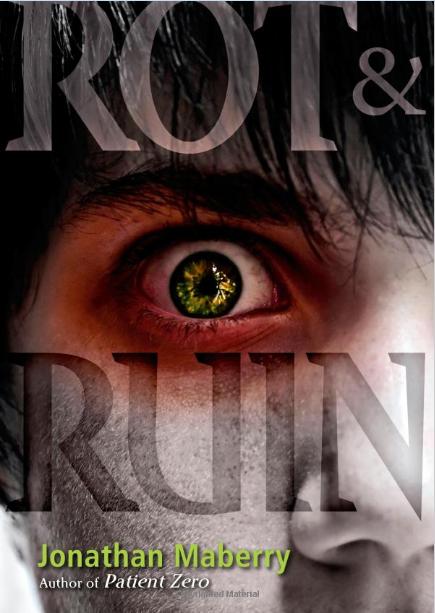
Reader Zombie = HAPPY! Dust and Decay arrived this afternoon. Back to actual fictional Zombie land!!! (It's the sequel to Rot and Ruin which I've blogged about a few times now that's also awesome). What else can I do with a sick kid who is coughing out a lung, other than trying not to get sick again myself. I was going to let my student read it first but now I'm 100 pages in and minus well just finish it. Hmmm... too tired to think.

Zombie nap = zzzzzzzzzzzzzzz

Monday, December 19, 2011

Connecting with kids through books

Wow, it's been nearly two weeks since my last post :/   

I blame Christmas to-do lists and sickness. And general laziness. Too many good movies on right now. So anyway, in the spirit of spreading holiday cheer, I wanted to recognize several students and teachers for recommending some of my favorite reads. All were inspired through vicarious experiences of their excitement in the reading. 

Looking around the classroom at the books kids are choosing to read, it is a wonder that we grown-ups put so little stock in the value of picking those same books up ourselves. We are constantly trying to push what we believe is appropriate and engaging reading material on students. But how often do we read what they actually like? It seems kind of backwards... 

Grown-ups tend to have much longer attention span, and what may take us only a chapter to quickly read and get sucked in, would bore a kid to the point of putting it down and walking away. Or even worse, we get to the middle school level and do fewer and fewer book talks, just when students are the least willing to find books on their own. And the biggest problem of all, is that the most popular titles that all the kids want to read, are the first ones to be re-checked out and wait-listed. 

How about we flip this around... let's look at what the kids are reading, that sucks them in quickly and keeps them grabbing for sequels, and see if we like it too. Obviously we have classics and required choices for in-class reading, but for strictly pleasure-reading, what are they picking? And are there educational ties, grammar and structural and thematic lessons in the text that could lead to some engaging class time?

I have very seldom been misled by a title recommended by a kid. Except Artemis Fowl. I got through the first four before I threw in the towel. In general, YA reading is chock-full of first loves, embarrassing social situations, coming of age and life-changing events, and the inevitable discovery of morals and strength the protagonists never knew they had. What more could you ask for? Honestly, that's a pretty similar tale to most grown-up literature I read too. Just without all the swearing, violence and sex.

I'll keep them down to initials so no one (or their parents) gets embarrassed or pissed off. Starting most recent, and working my way backwards... 
 
I may write a blog poking fun at zombies, but I never thought I'd actually enjoy reading about them. Thanks to G.Z. for loaning me this surprisingly engaging and action-packed post-modern apocalyptic tale! 

Rot & Ruin takes what I think is an entirely new perspective on how humanity may kill ourselves with technology and super viruses; as well as delving into the ethics behind killing zombies who were, at one time, family members and friends of some one. 

What right does one person have in taking the life of a zombie (even a math teacher!), if the zombie isn't hurting anyone? And is it cruel to torture a zombie, just because s/he can't feel pain? That we know of?

Previous to the zombie adventure, the same student had loaned me his copy of another tail of death and doom. Instead of dealing with the living dead, the Morpheus Road series (soon to be a trilogy) thrills with supernatural forces leading to a family secret that changes the main character's life. 

I wasn't nearly as engaged by the first book (The Light) as the second one (The Dark). The sequel retold the story of the first book, but from a deceased character's perspective. The unique way in which the after-life is portrayed really makes sense, and has altered my perception of what may wait for us after death in a similar fashion to the movie "What Dreams May Come".

Often in class while reading the first one, I would refer to the character and make metaphors between his conflicts in the book, and what we were studying in math (with linear relationships and independent/ dependent variables). By referring to memorable scenes and characters in the books, more students are likely to read them and share in the discussion.

My Hunger Games / Mockingjay t-shirt, and poster from an awesome colleague, have had a similar effect in bringing students together to talk to me and each other about the content. I love hearing about what scenes and ethical dilemmas inspire or disturb them, and what they feel that means for their own lives. So a big shout out to K.D. who I had in one lone trimester of Spanish, and was sneaking the books out every second she thought I wasn't looking (before, during and after instruction). Or just blatantly reading them in front of me. I finally gave in and downloaded the audio versions of all three books. 

After my first read, listening non-stop to the futuristic/ possible America/ dictatorship/ reality TV/ gladiator-style / teen romance / big-brother is watching your every move all wrapped into one, I wasn't sure if I would want to read them ever again. But I did. Twice. Some of the imagery is so violent and disturbing (especially in Mockingjay) that you wonder kids don't have nightmares about them. But they probably do. 

Once again, similar to the above novels, the main character is an older teenager, around 16, whose world is completely turned upside down. It is a very good message to kids to be thankful for what they have, and to appreciate the blessings of family, freedom, and security. And full bellies!

The title refers more to the gladiator-style games the teenage "tributes" play in, than to games about hunger. Although most of the characters have been hungry their hole lives, and nearly starve in the "arena". All three books are page-turners from start to finish.

Continuing to move back, I'll retreat to last spring, and thank my coworker J.K. for recommending When You Reach Me, after hearing about my interest in A Wrinkle In Time. The latter was a lit-circle choice when I was on 4th grade, and the former actually refers to it several times within the text. It is the favorite book of the protagonist, and the content of both books relates on several levels.

I would be tempted to start my own book talks when the content spills over into math and science topics, just to show the students how interrelated the disciplines really can be. Time travel, paradoxes, and multiple dimensions are not only fascinating, but foster interest in higher math, to make the content more understandable. 

Not to mention that one of the side characters repeatedly runs naked down the main street of the town in his attempts to land in the exactly right moment in his past to change his future. I don't remember where exactly he ended up finding clothes... I guess I'll have to read it again!

Moving further back through my own timeline, I'd like to thank the exuberant and bold J.R. for adamantly choosing Bella for her Spanish name, and not being afraid to shout to the world how wonderful the books were. That was at the height of their popularity, right as Breaking Dawn was debuting, sparking a controversy as to whether the 4th installment should be allowed in schools. (The characters marry and copulate and then talk about the copulations in a pretty PG-13 way). 

The Twilight Saga is, however, a fantastic read. Anyone who has seen only the movies is truly missing out. The books are told in first person, from Bella's perspective, and the viewer really misses out on 2/3 of the story, which is how Bella interprets and reacts to the insane events surrounding her. 

There are very few dull moments in any of the four books, and there are a surprisingly extensive number of references to classical literature, music and historical events dating back to the 1600's. Having read these, I have to thank the main character Bella, for finally inspiring me to pick up my next recommendation. 

Jane Austen's complete novel works. And Wuthering Heights. Yes, I said it, being the Zombie that I am... a fantasy book character finally was the last straw that made me want to read these British classics. After reading the Twilight series so many times, I wanted to know what was so interesting that Bella was going on and on and on about them through all four books. I had already read 1982 and Animal Farm and R&J of course in my own high school courses, but for some reason, we never read any Austen. Go figure. 

Bella nearly has a meltdown as she pulls out her beaten compilation of Austen novels, when she realizes that nearly every book has some character named Edward. Or Edmund. And she's right! Why does Jane Austen insist on using so many similar names in all her books? Honestly I don't really care. They're all equally wonderful. Although I have a picture here of Pride & Prejudice (I must read the zombie version soon!) my favorite Austen is probably Emma.

And now for a couple that are completely unrelated to the above, other than they were recommended by family members, who kept saying "you would love this!". Until I finally did read them. And yes, I did love them.

Take this book, Life of Pi... which is currently being made into a movie. My cousin was reading it, and lent it to me, so I read it quickly, and gave it back, and loved it... and wanted my own copy... which my sister didn't know about... and gave me a copy for my birthday this year anyway! Small world!! 

It is a very unique and odd book, also filled with disturbing images and a teenager coming of age. On a life raft. With a tiger. Lost at sea. Oh yeah, and his parents and their entire traveling zoo (sans Tiger) just drowned in a boat accident in the middle of the ocean. :(


My last recommendation has consistently been a favorite amongst teens, and is ALSO FINALLY being made into a movie!! Ender's Game is, and will probably always, be my favorite book of all time. The hold-up has of course been technology that can adequately support the vast futuristic environments and creatures that will need to look realistic if this is not going to flop. 

Set in the not-so-distant future, humanity has finally set limits on child-bearing rights due to the over-population of Earth. A powerful alien race similar to ants has come to invade the planet for a second time, and in preparation of their attacks, young genius children have been bred for battle command in outer space. Andrew (Ender) Wiggin arrives at Battle School with a lot to prove, being the youngest, one of the smallest, and by far the smartest kid to come through the zero-gravity training facility in many years. 

In the process of learning the ropes of Battle School, he hacks computers, gets into life-and-death struggles in the showers (it's more gory and less x-rated than it sounds), makes a number of dubious friends, and masters the art of the Zero-G lazer tag game that simulates and alien attack. His training starts out as a game, but it ends in a much different manner. A must-read. And then the sequel. And then that sequel, and that sequel, and the various prequels, and the parallel futuristic stories from Ender's perspective... just can't get enough. It's got everything. Love, Power, War, Ethics, Family... 

Now I'm starting to sound like Stefan, the "city correspondent" from SNL. Better stop while I'm ahead. And start correcting that pile-o-homework I've been putting off by writing this. Oops.

Wednesday, December 7, 2011

Warm fuzzies for No HW Week, Flip Lessons, and CHOICE!!!!


Here's another jewel from ICanHasACheezburger.com... seriously.... adding one of these a couple times a week to my Smart lessons makes the kids laugh out loud and lightens the whole mood of the class. I can't say enough for the importance of pre-screening material from their site, or any other, or for using Google Images at all... but if you take the time to add "funny" to whatever curriculum you're googling, you're bound to find something usable that will increase student interest exponentially. 

Which (exponents) just happens to be what my math classes are studying right now... so EXPERIMENT! Let's try it! Go to Google Images, type in "exponent + funny"... scroll down a few rows past the "real" math, and guess what shows up??? Here are a couple of my favorites, neither of which really has much to do with exponents...OK maybe the first one...

All this has absolutely nothing to do with my blog topic today at all, other than the choice I make every day to be random, unpredictable, and to relate to my students more like adults than children. Not to say that I try to push the line with appropriateness; rather, when they are misbehaving or refusing to follow directions, I redirect them with humor and/or sarcasm, as I would want to be treated. 

For me personally, and maybe this has to do with being a female teacher in a female dominated profession, I feel that middle school students are most likely to shut down when subjected to authoritarian behavior management. Most adults I know do too! Compared to authoritative teachers, who validate and respect their students' feelings and take the time to listen to their opinions and reasoning... Click this link to see an example of the difference between authoritative and authoritarian. I always get their names mixed up even though I know exactly what both philosophies mean.

Okay... so what was my point... oh yeah! That I wanted to send out a warm fuzzy to "choice" in the classroom. That it's okay to choose to act like a kid once in a while, or a lot of the while, so students let down their guard and actually look forward to coming to class, knowing that something new and different (and maybe even fun) will be learned each and every day. Also, the choice to offer students choices in curriculum has been one of the most liberating experiences of my teaching career. 

I can't quite say how or when "choice" really became a way of life for me. Other than even in my first few weeks of teaching in my first classroom ever in 2003, every kid seemed to have different expectations and motivation, and I never felt like one homework would work for all kids. So I set up the method of copying huge packets (as a time saver so I could have a life) and gave a grade of 8/10 for completing 80% of the homework, a 9/10 for 90% of the homework, and 10/10 for the entire thing. 


I had already chosen which problems they had to do, so everyone was required to do the "core" concepts. That way the high-achievers chose to work their tails off, and the not-so-motivated learners could choose to do the bare minimum and not feel guilty about it. We can't all be Einsteins after all. And he didn't particularly like school for that matter either. 

When I switched to my current district, that idea of differentiating based on prior knowledge stuck with me. My school's colors became the basis for the equivalent of a basic, intermediate and advanced level of homework expectations. I searched far and wide to do a better job of selecting homework problems, which took quite a long time, and there were many stumbles along the way. Then I began teaming with various special needs teachers, and discovered that not only homework assignments, but assessments also needed to be differentiated. After writing numerous modified tests, I began to think that maybe quizzes and tests could be differentiated too. 

Who says a pencil-and-paper unit test is the only way to assess math concept mastery? What if more projects and performance-based learning opportunities were provided? Could a student write an essay analyzing, comparing and contrasting various math concepts, and support their conclusions with formulas and examples? Doesn't that provide a clearer picture of the depth of a student's understanding? What if students are given the choice to write a vocabulary essay, instead of matching 20 words correctly? Isn't the essay a better tool to assess whether a student understands the meaning of the mathematical language? 

That sure opened a can of worms. Once I started opening up assessments to differentiated methods and learning styles, that lent itself naturally to offering homework for different learning styles as well. I discovered a life-changing way to teach from a book called Differentiating Instruction With Menus Grades 6-8: Math, by Laurie E. Westphal. Giving students the power to choose what path they took to knowledge, with the end curricular goal in mind, led to achievement and creativity that surpassed my wildest expectations. Using her templates for my first few homework "menus", I soon began creating my own, and developed my M.Ed. project around the idea of choice. 

Having piloted the menus last spring with mostly good student and parent reviews, I went all-out this year. We have had very few cookie-cutter, one-size-fits-all assignments. The kids shout out suggestions like "we want a hockey menu!" or "we want a baseball menu!" or "we want a swimming menu!" and then I fill in choices that meet the learning goals I want them to achieve, plus offering some extra choice assignments that they pick based on readiness, interest and/or ability. Here's an example of the one we're working on now.


I can just hear voices in the background saying, I could never do that, I'm not that creative... but it's honestly as simple as picking a theme, googling related images, and copying and pasting it all together. I use PowerPoint pretty exclusively, and the bonus with Microsoft 2010 is that when you go to "Save As", you can select ".pdf" from the file type menu, and get a much smaller, universal document that can be opened from any brand of computer. No Office product required. And much smaller to store and upload too. I usually save a second copy using the .pptx setting so I have an editable version too, in case something doesn't work the next time. Having two different class types as well, I keep the theme and then swap out the content listed; thus killing two birds with one stone!

If you're still with me now, you're probably wondering when the heck I'm going to talk about the rest of my titled topics. So thanks for wading through all my word-vomit to get this far. Here it is.... 

No Homework Week: EXCELLENT!!!!!!!!!!!!!!!!!! I totally hadn't planned what actually happened, which was that I got really sick with a hacking cold and body aches and ended up being out Tuesday/Wednesday. I had the best sub ever, and it was such a load off designing good lessons for her to work through at her own pace, and for the kids to not feel stressed about doing a homework that they didn't quite understand. 

When I came back, I just picked up the notes of where they stopped, and we jumped right back in. I didn't come back to a mountain of correcting, and/or angry parent emails and calls about the homework that nobody understood. And the kids got a break. Now I can't be certain, but that brain break certainly seemed to pay off... because THIS week, they are incredibly motivated and an insanely high amount of students are done with the entire week's worth of work, and has moved onto extra credit and extensions! Maybe I should do this more often! Highly recommended. For the sanity of teachers and students.

Flip-Class: It's BAAAAAAAAAAAAAAACK! Every time I mention flip-class, the kids get super excited. "We don't have to listen to Mrs. Bellm talk all day today!!!!!!!" "We can work with our friends!!!!!!" "We can work at our own pace!!!!!" "We already know how to do this and are ready to finish it up and move onto something harder and more fun!!"

I added a second component to Flip-Class... Flipped Warm-Ups! Each warm-up is split into a review of the concept from the day before, and a brief battery of problems on the new concept for the current day. As we correct both parts, I teach a quick overview of the new concept, which is often enough for the top 33% to get it, and they go off to the "Dharma Initiative" and complete their work, start extensions, or go play math games on the math sections of my website. 

Every day that I teach with flip-class, I find myself less tired from talking, more connected to my students, and completely energized to keep doing it. Everyone is getting what they need, and absent students or those who need more practice have an easily accessible flip-lesson on my website that I DON'T HAVE TO TEACH!!!! Not to mention, it's helpful for parents too. Both for accountability's sake, and for them being able to help with homework. Or heck, maybe even to learn it themselves! 

Maybe it's just me... maybe my students are really really smart... but I feel like we move faster through curriculum with flip-lesson. I know that next week will go faster, because I'm going to offer a FLIP-QUIZ too! All this really means, is that students can take it when they want to. I may even give them a "second chance" attempt if they bomb the first one. Which means... drumroll.... MORE CHOICE!!! YEAH! 

In conclusion, I use way too many exclamation points. Can you tell I love my job?? Okay bye.